
by Haoxin Safety
Share
by Haoxin Safety
Share
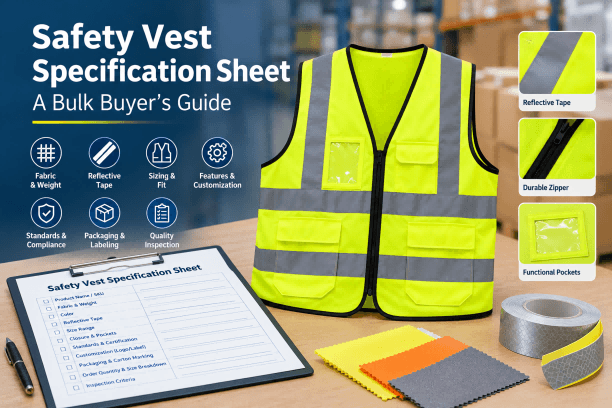
When ordering high-visibility safety vests in bulk, a clear product specification sheet helps buyers communicate requirements, compare supplier quotations, and reduce misunderstandings before production begins. Without written specifications, seemingly minor differences in fabric, reflective tape, sizing, or packaging can lead to inconsistent deliveries and additional costs.
For importers, wholesalers, safety equipment distributors, and private-label brands, a well-prepared specification sheet is an essential purchasing tool. It defines what the supplier needs to manufacture, what the buyer expects to receive, and which details must be checked before shipment.
This guide explains how to build a practical safety vest specification sheet for bulk orders, from basic product information to compliance documentation and final quality inspection.
1. Define the Intended Application and Safety Requirements
Start by identifying where the vests will be used. A vest designed for warehouse identification may have different requirements from one used by road construction crews, railway maintenance teams, or workers operating near moving vehicles.
Your specification sheet should identify:
- Industry and application: Construction, roadwork, logistics, warehousing, utilities, or general industrial use.
- Working environment: Indoor or outdoor use, daylight or nighttime work, and expected weather conditions.
- Visibility requirements: The required garment class or performance level under the applicable standard.
- Target market: The country or region where the vests will be sold or used.
- Special requirements: Compatibility with other PPE, role identification, or additional workplace-specific features.
For example, buyers supplying roadwork contractors may need to specify a particular high-visibility performance class, while warehouse distributors may prioritize lightweight fabric, easy identification, and economical bulk packaging.
Do not select a compliance class based on appearance alone. Confirm the applicable workplace requirements and ensure that the complete garment meets the relevant standard.
2. Specify the Base Fabric and Material Weight
The base fabric affects breathability, durability, comfort, appearance, and overall product cost. Buyers should state the required fabric type instead of relying on descriptions such as “standard quality” or “premium material.”
| Specification | What to Confirm |
|---|---|
| Fabric type | Polyester mesh, solid polyester, or another agreed material. |
| Fabric weight | Target weight in grams per square meter (GSM), with an agreed tolerance if applicable. |
| Color | Fluorescent yellow, orange, or another approved color reference. |
| Construction | Fabric structure, edge finishing, seam quality, and reinforcement requirements. |
| Performance | Any required durability, colorfastness, or other verified material performance criteria. |
Polyester mesh is commonly selected for lightweight, breathable vests used in warm environments. Solid fabrics may be preferred when buyers want a different appearance or a more structured surface for printing and pockets.
Where fabric weight is important, specify a target value and acceptable tolerance. Requesting a sample for approval can also help establish the expected texture, color, and construction before mass production.
3. Document Reflective Tape Requirements
Reflective tape is a critical specification for high-visibility safety vests. The required material and layout should be determined by the intended application and applicable performance standard.
Include the following details in your specification sheet:
- Tape width: State the required width in millimeters or inches.
- Tape placement: Specify the required arrangement across the front, back, shoulders, or other approved areas.
- Material type: Identify the approved reflective tape material and product reference where available.
- Attachment method: Specify sewn-on, heat-applied, or another approved construction method.
- Performance requirements: Reference the applicable standard and any required test documentation.
- Consistency: Require tape placement and construction to match the approved sample and technical drawing.
A vest can look similar to another product but differ in reflective material, coverage, or verified performance. Buyers should therefore avoid using tape color or appearance as the only acceptance criterion.
For relevant background, see our article on surveyor safety vests, functionality, compliance, and durability.
4. Set the Required Safety Standard and Documentation
Safety requirements should be stated explicitly in the purchasing specification. Depending on the target market and application, buyers may need to reference standards such as ANSI/ISEA 107 in the United States or EN ISO 20471 in applicable European markets.
These standards are not interchangeable. Confirm the current applicable edition, the required garment classification, and the conformity assessment or certification requirements for the intended market.
Your specification sheet should record:
- The required standard and edition, where applicable.
- The required garment class or performance level.
- The exact product model covered by the supporting documentation.
- Available test reports, certificates, declarations, or other required compliance records.
- Any required garment markings, labels, or traceability information.
Ask the supplier to confirm that the documentation applies to the actual garment being quoted, including the relevant materials and reflective components. Do not assume that a certified tape automatically makes the finished vest compliant.
5. Define Sizes, Measurements, and Fit
Size labels alone are not sufficient for bulk purchasing. Different suppliers may use different patterns, grading rules, or measurement methods, even when the labels show the same size.
For more consistent orders, request a measurement chart covering:
- Chest width or chest circumference.
- Body length from a clearly defined reference point.
- Shoulder width or other relevant dimensions, depending on the design.
- Size range, such as S to 4XL, based on the actual product offering.
- Measurement tolerances and the method used to measure the garment.
Also confirm whether the vest is intended to be worn over a T-shirt, uniform, jacket, or other protective clothing. The expected layering affects the fit and required garment dimensions.
For distributor orders, an approved size chart and a sample in representative sizes can reduce returns and complaints. If multiple sizes are included in one shipment, state the quantity required for each size rather than giving only the total order quantity.
6. List Closures, Pockets, and Functional Features
Functional details should be documented individually so the supplier can quote the correct design and reproduce it consistently.
| Feature | Information to Include |
|---|---|
| Front closure | Zipper, hook-and-loop fastening, snaps, or another specified closure. |
| Pockets | Number, dimensions, location, opening style, and intended use. |
| ID holder | Required position, size, and transparent material, if applicable. |
| Radio or tool loops | Quantity, placement, and any reinforcement requirements. |
| Edge finishing | Binding material, color, seam finish, and other visual requirements. |
| Special construction | Breakaway features or other design requirements where the application calls for them. |
For example, a basic warehouse vest may need only a front closure and a simple pocket layout. A surveyor vest may require multiple tool pockets, radio holders, and reinforced areas.
Any breakaway design should be specified according to the actual workplace hazard and intended product design. Do not add or remove such features without confirming the safety requirements.
7. Specify Logo Printing and Private-Label Requirements
For distributors and private-label brands, branding details should be agreed before production begins. A logo that looks correct on a digital mockup may appear different on mesh fabric or after application to the finished garment.
Record the following requirements:
- Logo artwork file and approved colors.
- Printing or application method.
- Logo dimensions and exact placement.
- Required company labels, size labels, and care instructions, where applicable.
- Packaging artwork, barcode, SKU, and language requirements.
- Approval process for samples or pre-production mockups.
Ask the supplier to provide a visual proof before producing customized goods. For large orders, confirm whether the final sample must be approved in writing before mass production.
For more details, read our guide to designing custom safety vests with the right fabrics, reflective tapes, and printing methods.
8. Confirm Packaging, Carton Marking, and Order Quantities
Packaging requirements can affect warehouse handling, shipping efficiency, and the buyer’s ability to distribute products to different customers. These details should be agreed before the quotation is finalized.
- Individual packaging: Specify whether each vest requires a polybag or another form of protection.
- Units per carton: Confirm the quantity packed in each master carton.
- Carton dimensions and weight: Request estimated measurements and gross weight for freight planning.
- Carton markings: Identify the product name, SKU, size breakdown, quantity, and destination-specific labels where required.
- Quantity breakdown: State total units and the quantities of each color, size, or design.
- Delivery requirements: Confirm the requested delivery schedule and any shipment-specific packaging instructions.
If the order includes several sizes or colors, ask the supplier to confirm the packing arrangement in advance. This makes receiving, stock counting, and onward distribution easier.
9. Establish Sample Approval and Quality Inspection Criteria
A detailed specification sheet becomes more useful when it is linked to an agreed inspection process. Buyers should establish which characteristics will be checked before production, during manufacturing, and before shipment.
Consider including the following checkpoints:
- Pre-production sample: Confirm the fabric, color, dimensions, reflective tape layout, closures, pockets, and branding.
- Material verification: Check that the production materials match the approved specifications.
- Dimensional inspection: Measure garments against the agreed size chart and tolerances.
- Visual inspection: Check for stains, damaged fabric, loose threads, uneven stitching, and incorrect components.
- Reflective tape inspection: Verify the specified width, placement, attachment, and applicable performance documentation.
- Packaging inspection: Confirm unit counts, size assortments, labels, and carton markings.
- Final acceptance: Agree on the inspection method, sampling plan, defect classification, and corrective-action procedure before production.
Where formal compliance or performance testing is required, visual inspection alone is not enough. Testing should follow the relevant method and acceptance requirements.
Buyers should also retain the approved sample, specification sheet, and relevant order records. These documents provide a reference if future orders need to be compared with the original production batch.
10. Use a Practical Safety Vest Specification Sheet Template
The following checklist can be adapted for supplier inquiries and purchase orders. Fill in the fields relevant to your product and mark any undecided items for confirmation before production.
| Specification Item | Buyer Requirement |
|---|---|
| Product name / SKU | ________________________ |
| Intended application | ________________________ |
| Target market and applicable standard | ________________________ |
| Required garment class | ________________________ |
| Base fabric and target GSM | ________________________ |
| Fabric color | ________________________ |
| Reflective tape type and width | ________________________ |
| Reflective tape layout | ________________________ |
| Size range and measurement tolerances | ________________________ |
| Closure and pocket configuration | ________________________ |
| Logo, labels, and customization | ________________________ |
| Individual packaging and carton quantity | ________________________ |
| Total order quantity and size breakdown | ________________________ |
| Required documents and test reports | ________________________ |
| Sample approval and inspection criteria | ________________________ |
Attach reference photographs, technical drawings, logo artwork, and any required compliance documents to the specification sheet. If a field is not applicable, mark it accordingly rather than leaving room for different interpretations.
11. How a Complete Specification Sheet Improves Bulk Purchasing
A clear specification sheet helps both the buyer and manufacturer work from the same requirements. It also makes supplier quotations easier to compare because each supplier is pricing the same material, construction, features, packaging, and compliance expectations.
For procurement teams, the main benefits include:
- More comparable quotations: Suppliers can quote against consistent technical requirements.
- Fewer production misunderstandings: Key details are documented before manufacturing begins.
- Better quality consistency: Approved samples and measurable requirements provide a reference for inspection.
- More accurate cost planning: Fabric, tape, pockets, printing, packaging, and order quantities are clearly defined.
- Smoother repeat orders: Saved specifications help maintain consistency when replenishing inventory.
When evaluating suppliers, buyers should consider not only the unit price but also the supplier’s ability to understand technical requirements, provide appropriate documentation, maintain production consistency, and support repeat orders.
Quick Summary
- Define the intended application and target-market safety requirements first.
- Specify fabric type, weight, color, reflective tape, and garment construction.
- Document sizes, measurements, closures, pockets, and customization details.
- Confirm applicable standards and product-specific supporting documentation.
- Set packaging, carton marking, quantity breakdown, and delivery requirements.
- Approve a sample and agree on inspection and acceptance criteria before mass production.
- Keep the final specification sheet and approved sample as references for repeat orders.
Frequently Asked Questions
What should a safety vest specification sheet include?
It should include the product model, intended application, applicable safety requirements, fabric type and weight, color, reflective tape details, sizing, closures, pockets, branding, packaging, order quantities, required documentation, and quality inspection criteria.
Why are detailed specifications important for bulk safety vest orders?
Detailed specifications help buyers obtain comparable quotations, reduce misunderstandings, verify production quality, and maintain consistency across different orders. They also help suppliers calculate costs based on the actual product requirements.
Which safety vest standard should bulk buyers specify?
The correct standard depends on the intended application and target market. ANSI/ISEA 107 is relevant to high-visibility apparel in the United States, while EN ISO 20471 is used in applicable European and other markets. Buyers should verify the current requirements and the specific garment’s supporting documentation before ordering.
Should buyers approve a sample before bulk production?
Yes. A pre-production sample helps buyers confirm the fabric, color, fit, reflective tape layout, functional details, and branding. The approved sample and specification sheet can then serve as references for production and final inspection.
How can distributors reduce quality differences between repeat orders?
Keep a controlled specification sheet, retain the approved sample, define measurable tolerances, and request confirmation of any proposed material or construction changes. Agree on inspection procedures and documentation before each production run.
Source Safety Vests with Clear, Consistent Specifications
For importers, wholesalers, and safety equipment distributors, successful bulk purchasing starts with clear communication. A complete specification sheet helps align product design, compliance requirements, quality expectations, and packaging before production begins.
HaoXin Safety Wear manufactures high-visibility reflective vests and offers product options for different industrial applications. Buyers can explore the reflective safety vest product range and discuss material, design, branding, and order requirements with the team.
Prepare your specifications, share your target quantities, and request a quotation based on the exact product configuration you need.