
by Haoxin Safety
Share
by Haoxin Safety
Share
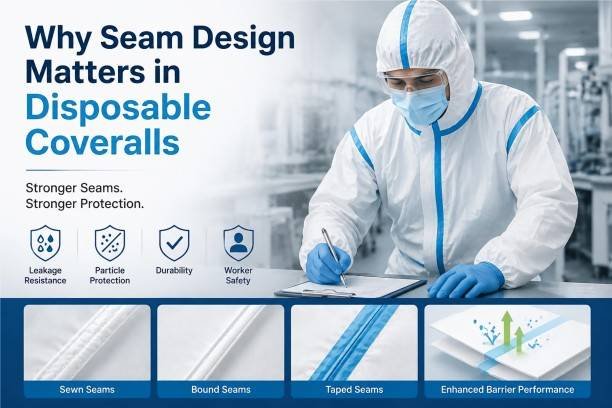
Introduction: The Hidden Factor Behind Disposable Coverall Performance
When buyers evaluate disposable coveralls, they often focus on fabric type, weight, and certification.
However, one critical factor is frequently overlooked: seam design.
A protective coverall can use high-performance fabric, but if the seams are poorly designed, they may become weak points where particles, liquids, or contaminants can enter.
For industries that require reliable protection, seam construction plays an important role in overall garment performance.
This is especially important in applications such as:
- Chemical handling
- Pharmaceutical manufacturing
- Healthcare
- Laboratory work
- Industrial cleaning
- Hazardous material control
What Is Seam Design in Disposable Coveralls?
Seam design refers to the way different fabric panels are joined together during the manufacturing process.
In disposable protective clothing, seams affect:
- Barrier performance
- Particle penetration resistance
- Liquid resistance
- Garment durability
- Worker protection
The seam is not simply a connection point. It is part of the protective system.
A well-designed coverall considers both:
- Fabric performance
- Seam performance
Why Seams Are Critical in Protective Clothing
1. Seams Can Become Potential Leakage Points
The main purpose of disposable coveralls is to create a protective barrier.
However, areas where fabric pieces are connected may have small openings or gaps.
Without proper seam construction, risks include:
- Liquid penetration
- Dust leakage
- Contamination transfer
For high-risk environments, seam quality can directly influence the protection level of the entire garment.
2. Seam Design Affects Certification Performance
Protective clothing standards do not only evaluate fabric.
Testing may consider the complete garment structure, including:
- Material performance
- Seam strength
- Resistance against penetration
For example:
- Type 5 coveralls focus on protection against airborne solid particles.
- Type 6 coveralls focus on limited liquid splash protection.
The seam design helps ensure the garment performs consistently with its intended protection level.
Common Seam Types Used in Disposable Coveralls
1. Sewn Seams
Sewn seams are one of the most common construction methods used in disposable protective clothing.
Advantages include:
- Efficient production
- Suitable for general applications
- Cost-effective manufacturing
Common uses:
- Basic protective clothing
- Low-risk industrial environments
However, standard sewn seams may provide limited barrier performance compared with reinforced designs.
2. Bound Seams
Bound seams use additional material to cover the stitching area.
Benefits include:
- Improved durability
- Reduced exposure through stitching holes
- Better overall protection
They are often used where stronger garment performance is required.
3. Taped Seams
Taped seams use sealing tape applied over the stitched area to improve garment protection.
Advantages include:
- Improved liquid resistance
- Reduced particle penetration
- Enhanced barrier performance
Common applications:
- Chemical protection
- Pharmaceutical environments
- High-contamination areas
How Seam Design Influences Different Industries
Chemical Industry
Chemical environments often require protection against:
- Liquid splashes
- Hazardous substances
- Chemical contamination
In these applications, seam construction is as important as fabric selection.
A microporous coverall with reinforced seams may provide better protection than a similar garment with standard stitching.
Pharmaceutical Manufacturing
Pharmaceutical production requires strict contamination control.
Workers need protective clothing that helps prevent:
- Product contamination
- Particle release
- Cross-contamination
Seam quality contributes to maintaining controlled production environments and helps reduce unwanted particle transfer during manufacturing processes.
Healthcare and Laboratories
Healthcare and laboratory environments may involve exposure to:
- Biological materials
- Contaminated liquids
- Infectious agents
Protective garments used in these applications often require reliable seam performance combined with appropriate standards such as EN 14126.
Food Processing
Food manufacturers use disposable protective clothing to maintain hygiene and prevent contamination during production.
Good seam design helps:
- Reduce contamination risks
- Maintain garment integrity
- Improve worker confidence
Seam Design vs Fabric Selection: Which Is More Important?
Many buyers ask whether fabric or seam design matters more when selecting disposable coveralls.
The answer is that both are important.
A high-performance fabric with poor seam construction may not provide the expected protection level.
A well-designed seam system helps maximize the performance of the selected material and improves the overall reliability of protective clothing.
Professional PPE selection should consider:
| Factor | Importance |
|---|---|
| Fabric type | Determines barrier performance |
| Seam construction | Controls leakage risks and improves protection reliability |
| Certification | Confirms tested protection level |
| Garment design | Improves overall coverage and wearing comfort |
How PPE Buyers Should Evaluate Seam Quality
Before purchasing disposable coveralls, buyers should evaluate not only the fabric specification but also the seam construction process.
1. Seam Construction Method
Professional buyers should ask suppliers:
- What type of seam is used?
- Are seams reinforced?
- Are seams taped or sealed?
2. Application Suitability
Different industries require different seam solutions.
For example:
- General maintenance may require standard seams.
- Chemical applications may require sealed or taped seams.
- Clean environments may require higher control levels.
3. Supplier Manufacturing Capability
A reliable disposable coverall manufacturer should have:
- Experienced production teams
- Quality inspection procedures
- Consistent sewing processes
- Export compliance experience
Common Mistakes When Buying Disposable Coveralls
Choosing Only Based on Fabric Weight
A heavier fabric does not automatically mean better protection.
Protection performance depends on multiple factors, including material structure, certification, seam design, and garment construction.
Ignoring Seam Details
Many buyers compare materials but overlook construction quality.
However, seams can directly influence leakage resistance and overall garment performance.
Selecting Products Without Application Testing
Protective clothing should match the actual working environment.
Before bulk purchasing, buyers should evaluate product samples and confirm suitability for the intended application.
Focusing Only on Price
Lower-cost products may reduce performance in critical areas such as seams, closures, and overall manufacturing consistency.
Frequently Asked Questions
Why are seams important in disposable coveralls?
Seams affect the overall protection performance of disposable coveralls because they influence liquid resistance, particle penetration, durability, and contamination control.
Are taped seams better than sewn seams?
Taped seams generally provide higher barrier protection, especially for liquid and contamination risks. However, the best choice depends on the application and required protection level.
Do all disposable coveralls have the same seam design?
No. Different disposable coveralls use different seam constructions depending on protection requirements, industry standards, and intended applications.
What should PPE buyers ask manufacturers about seams?
Buyers should ask about seam type, testing standards, production processes, quality control procedures, and whether the product is suitable for their specific working environment.