
by Haoxin Safety
Share
by Haoxin Safety
Share
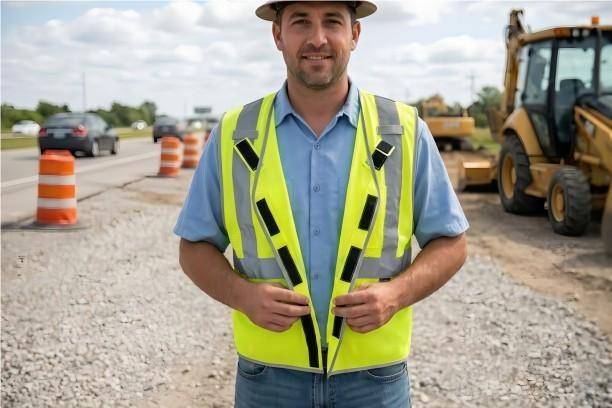
In the world of high-risk labor, “visibility” is usually the first word that comes to mind when discussing safety vests. However, for many professionals, visibility is only half the battle. The breakaway safety vest represents a critical evolution in personal protective equipment (PPE), designed to protect workers not just from what they can’t see, but from the very gear they are wearing.
What is a Breakaway Safety Vest?
Unlike a standard high-visibility safety vest that is stitched together as a solid garment, a breakaway vest is designed to fail—by design. It features a system of hook-and-loop (Velcro) or snap fasteners at strategic points. If the vest is snagged, pulled, or caught, these fasteners release under tension, allowing the garment to fall away from the wearer’s body instantly.
The industry standard is the 5-point breakaway system, where the vest detaches at:
-
Both shoulders
-
Both sides (waist)
-
The front closure
The Critical Need for “Breakaway” Functionality
The primary purpose of this design is to prevent entanglement and “caught-in” accidents. In many industrial and traffic environments, a standard vest can actually become a hazard:
-
Machinery Entanglement: If a worker stands too close to a conveyor belt, spinning rotor, or moving part, a standard vest could pull the person into the machine. A breakaway vest ensures the worker stays safe while the machine only takes the fabric.
-
Traffic and Roadwork: For workers near moving vehicles, a protruding side-mirror or door handle could snag a vest. Without a breakaway feature, the worker could be dragged at high speeds.
-
Physical Altercations: Public safety officers and first responders often wear breakaway vests to prevent an assailant from using the garment to pull, choke, or restrain them during a struggle.
Industry Standards and Compliance
While the breakaway feature is mechanical, these vests must still meet rigorous visibility standards. In the United States, they are governed by ANSI/ISEA 107. This ensures that even with the five separate panels, the vest provides:
-
Fluorescent Background Material: For daytime visibility.
-
Retroreflective Strips: For 360-degree visibility in low-light or nighttime conditions.
Who Should Wear One?
Breakaway vests are recommended—and often mandated—for several high-stakes professions:
-
Railroad Workers: Essential for working around moving trains and switching tracks.
-
Sanitation Workers: Crucial when operating hydraulic lifts and trash compactors.
-
First Responders: Police, Fire, and EMS personnel who work in unpredictable environments.
-
Warehouse Personnel: For those working near automated sorting systems and heavy forklifts.
Conclusion
In safety, we often focus on preventing external threats. The breakaway safety vest is a reminder that sometimes, safety means ensuring our own equipment doesn’t become a liability. By prioritizing a “fail-safe” design, these vests provide workers with an extra layer of defense, ensuring that if they ever get caught in a tight spot, they can walk away—literally.