
by Haoxin Safety
Share
by Haoxin Safety
Share
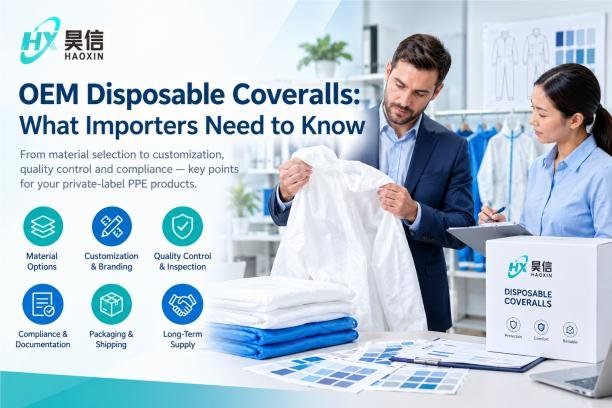
OEM Disposable Coveralls: What Importers Need to Know
For PPE importers, launching a private-label disposable coverall product involves more than adding a logo to existing packaging. The fabric, garment design, seam construction, sizing, quality requirements, and production consistency all influence the product that ultimately reaches the customer.
OEM disposable coveralls can give distributors greater control over their product range, branding, and market positioning. However, successful OEM purchasing depends on choosing the right manufacturing partner and defining product requirements before production begins.
A supplier may offer attractive prices and flexible customization, but those advantages only become valuable when the finished products meet agreed specifications and can be supplied consistently.
This guide explains what importers should consider when sourcing OEM disposable coveralls from China, including customization options, material selection, quality control, documentation, and long-term supply planning.
Quick Summary
OEM disposable coveralls require more than customized branding. Importers should define fabric, garment design, seam construction, sizes, packaging, performance requirements, and inspection criteria before placing an order. A reliable manufacturer should be able to communicate clearly about production capabilities, product limitations, and quality consistency.
1. What Does OEM Mean in Disposable Coverall Manufacturing?
OEM stands for Original Equipment Manufacturer. In the disposable protective clothing industry, the term is commonly used when a manufacturer produces products according to a buyer’s specifications, brand requirements, or agreed product design.
The exact meaning of OEM can vary between suppliers. Some manufacturers use OEM to describe private-label products based on existing designs, while others offer more extensive customization of materials, dimensions, packaging, and construction.
Importers should therefore clarify what the supplier actually includes in its OEM service rather than relying on the term alone.
OEM vs. ODM: What Is the Difference?
OEM projects generally begin with a buyer’s established product requirements or specifications. ODM, or Original Design Manufacturer, usually refers to a supplier that offers an existing product design or develops a product based on its own design and manufacturing capabilities.
In practice, the two models can overlap. A buyer may select an existing coverall style, request a different material or color, and add private-label packaging.
| Item | OEM / Private Label | ODM |
|---|---|---|
| Starting point | Buyer specifications or an existing product | Supplier’s existing design or development capability |
| Customization | Branding, packaging, and agreed product details | May include product design and specification adjustments |
| Buyer responsibility | Define and approve product requirements | Evaluate the supplier’s design and product suitability |
The most important point is simple: confirm the exact product and service scope in writing before production starts.
2. Why Are Importers Choosing OEM Disposable Coveralls?
Private-label protective clothing allows distributors and importers to build a product range under their own brand. Instead of competing only on generic products and unit price, buyers may develop a clearer market position through packaging, specifications, and product selection.
Brand Development
Custom packaging and product labeling can help distributors maintain a consistent identity across their PPE range. This is particularly relevant for wholesalers supplying regional industrial customers, safety retailers, or specialized distribution channels.
Product Differentiation
OEM does not always mean developing an entirely new garment. Buyers can differentiate products through agreed combinations of fabric, color, hood design, cuff construction, seam type, sizing, and packaging.
For example, one distributor may focus on economical general-purpose coveralls, while another may develop a product range for painting, industrial maintenance, or controlled working environments.
Supply and Specification Control
An established OEM specification gives buyers a reference point for future orders. When the material, measurements, packaging, and quality requirements are documented, it becomes easier to compare subsequent batches with the approved product.
This does not eliminate the need for inspections. It creates a clearer basis for checking whether production meets the agreed requirements.
3. Choosing the Right Disposable Coverall Material
Material selection is one of the first decisions in an OEM disposable coverall project. Different fabrics offer different levels of comfort, barrier performance, durability, and breathability.
The appropriate material depends on the intended work environment and the protection requirements established through a risk assessment.
PP Nonwoven Coveralls
Polypropylene nonwoven coveralls are commonly used for selected general-purpose applications where lightweight coverage and economical product costs are important.
They may be suitable for tasks involving dust, dirt, or basic hygiene control, depending on the garment design and applicable requirements. Standard PP nonwoven fabric should not automatically be treated as chemical-resistant protective clothing.
SMS Coveralls
SMS fabric combines spunbond and meltblown nonwoven layers. It is used in selected disposable protective clothing applications where a balance of comfort and material structure is required.
The performance of an SMS coverall depends on the fabric construction, garment design, and intended use. Importers should request product-specific performance information rather than assuming that every SMS garment offers the same protection.
Microporous Coveralls
Microporous coveralls typically use a film-based or laminated material construction designed to provide a barrier against selected liquids and particles.
They are commonly considered for applications such as industrial maintenance, painting, and other work environments where additional barrier performance may be required.
The presence of a microporous film does not, by itself, prove resistance to every chemical or liquid. The relevant performance must be established through appropriate product testing and documentation.
How Should Importers Compare Materials?
| Material | Typical Considerations |
|---|---|
| PP Nonwoven | Lightweight coverage, economical positioning, general-purpose applications |
| SMS | Nonwoven layered construction, comfort, application-specific barrier requirements |
| Microporous | Film-based barrier construction, liquid and particle protection requirements |
These are general material considerations, not a substitute for product-specific performance testing. The same material category may be available in different weights, constructions, and designs.
4. OEM Customization: What Can Importers Request?
Customization options depend on the manufacturer’s production capabilities, existing product designs, and order requirements. Importers should distinguish between standard options and changes that require additional development or production arrangements.
Fabric and Material Specifications
Buyers may request a specific fabric type, material weight, color, or construction. Any change should be documented clearly, including applicable tolerances and performance requirements.
Material weight alone does not establish the protective performance of a garment. A higher GSM value does not automatically mean that the coverall provides a higher level of chemical or particle protection.
Garment Design
Depending on the product and factory capability, OEM customization may include:
- Hood and collar design
- Elasticated wrists and ankles
- Elasticated waist
- Zipper and zipper flap configuration
- Seam construction
- Thumb loops or other design features
- Size range and garment dimensions
Not every option is available for every material or existing production line. Buyers should confirm whether the requested design can be manufactured consistently at the required order quantity.
Color Selection
Color may be selected for branding, product identification, or application-specific preferences. Common disposable coverall colors include white, blue, and other options depending on the material and design.
For industrial applications, the selected color should be evaluated alongside the intended working environment and product requirements.
Custom Logo and Labeling
Branding options may include printed packaging, carton labels, product labels, and other agreed brand elements.
Importers should confirm the printing method, artwork requirements, color references, label placement, and approval process before mass production.
5. Product Design Matters More Than a Logo
One common mistake in OEM purchasing is to treat branding as the main customization decision. A logo may be easy to change, but the garment design and manufacturing specifications determine how the product is made and evaluated.
Two disposable coveralls can look similar in photographs while differing in material, seam construction, sizing, and performance characteristics.
Seam Construction
Seams are important because they connect the garment panels and may influence barrier performance. Different applications may require different seam designs, including serged seams, bound seams, or taped seam constructions.
The appropriate seam type depends on the garment’s intended protection requirements. Buyers should not assume that a particular seam construction is suitable for every hazard.
Zipper and Closure Design
Zippers and other closures affect how a garment is put on, adjusted, and used. The design may also influence coverage and protection at the front opening.
Importers should confirm closure specifications and, where relevant, how the closure design is considered within the garment’s performance evaluation.
Sizing and Fit
A coverall should provide sufficient coverage while allowing the wearer to move and perform the required tasks. Size specifications should include agreed measurements and tolerances.
Buyers should request size charts and evaluate samples using the intended wearer profile. A nominal size such as XL or 2XL is not a universal measurement across all manufacturers.
Why Product Design Affects Purchasing Decisions
A customized logo does not change the underlying performance of a protective garment. The material, seams, closures, and overall construction must be suitable for the application and any claimed protection level.
Importers should therefore review the complete garment specification before approving an OEM order. This approach helps align branding decisions with product quality and customer expectations.
6. Understanding Protection Levels: Type 5 and Type 6
For importers sourcing protective coveralls, understanding the difference between Type 5 and Type 6 is important when selecting a product for a specific application. These classifications relate to defined protective clothing performance requirements and should not be treated as general guarantees of protection against every workplace hazard.
Type 5: Protection Against Dry Particles
Type 5 protective clothing is designed for protection against certain hazardous dry particles, subject to the applicable testing requirements. It is commonly considered in environments where airborne particles may present a risk.
The garment’s overall design, seams, closures, and material construction all contribute to its performance. A coverall made from a particular fabric is not automatically Type 5 certified.
Type 6: Limited Protection Against Liquid Splashes
Type 6 protective clothing is intended to provide limited protection against light liquid spray or splashes under specified test conditions.
It is not equivalent to full protection against all liquids, chemicals, or continuous exposure. Buyers should review the relevant product classification, test documentation, and application requirements before making a purchasing decision.
What Importers Should Check
- Applicable protective clothing classification
- Relevant test reports and technical documentation
- Garment design and seam construction
- Intended workplace hazards and exposure conditions
- Destination market requirements
If your customers require certified protective clothing, clarify the specific standard and performance requirements before confirming the product design. A supplier’s general description, such as “chemical resistant” or “high protection,” should not replace documented product information.
7. Compliance and Documentation for OEM Coveralls
Compliance is a key consideration when importing disposable protective clothing. The requirements depend on the product category, intended use, destination market, and claims made about the garment.
A buyer should identify the applicable regulatory framework before approving the final product. The manufacturer can then provide relevant technical information and documentation for review.
European Market Requirements
For protective clothing placed on the European market, importers should determine whether the product falls within the scope of the applicable personal protective equipment requirements.
Where relevant, buyers should review the product’s conformity documentation, applicable harmonized standards or other recognized technical specifications, and the conditions under which the product’s protective claims have been evaluated.
CE marking is not simply a quality logo. It is associated with applicable conformity requirements, and the specific obligations depend on the product and legislation.
Documentation to Discuss with the Supplier
- Product technical specifications
- Applicable test reports
- Conformity documentation, where required
- Material and garment construction details
- Labeling and packaging information
- Batch identification and traceability records
Importers should independently verify that the documentation matches the actual product being purchased. A certificate for one garment design or material should not automatically be assumed to cover every customized version.
Compliance Is a Product-Specific Question
Changing the fabric, seam construction, closure system, or garment design may affect the product’s performance and the scope of existing documentation.
If an OEM project involves substantial product changes, the buyer and manufacturer should determine whether additional testing or documentation is needed before commercial production.
8. How to Evaluate an OEM Factory’s Manufacturing Capability
A supplier’s ability to print custom packaging does not necessarily demonstrate its ability to manufacture a consistent protective garment. Importers should assess the production capabilities that are relevant to their specific product requirements.
Production Equipment and Processes
Ask the manufacturer which production processes are handled in-house. Depending on the coverall design, this may include fabric handling, cutting, sewing, seam processing, finishing, inspection, and packaging.
Understanding the production workflow helps buyers identify where quality checks take place and how changes to the specification may affect manufacturing.
Production Capacity
Production capacity should be discussed in relation to the actual product, order quantity, and delivery schedule. A factory’s overall output does not necessarily represent the capacity available for a particular OEM project.
Useful questions include:
- What is the normal production lead time?
- How are large orders scheduled?
- Can the factory maintain the approved specifications across batches?
- How are production delays communicated?
- What is the process for handling urgent or repeat orders?
In-House Production vs Outsourced Processes
Some suppliers may rely on external partners for selected materials, processing, or packaging operations. This is not automatically a problem, but buyers should understand which party is responsible for quality and delivery.
Clear communication about the manufacturing arrangement helps importers evaluate traceability, quality responsibility, and supply continuity.
9. Quality Control in OEM Disposable Coverall Production
Quality control should be considered from the beginning of an OEM project, not only after the goods are finished. The inspection process should reflect the agreed product specifications and intended application.
Incoming Material Inspection
Materials should be checked against the applicable purchasing specifications. Depending on the product, this may involve material identification, weight, color, physical characteristics, and other agreed requirements.
Importers should ask how the factory identifies raw material batches and manages deviations from the approved specification.
In-Process Inspection
In-process checks help identify manufacturing issues before the finished products are packaged. Areas of attention may include garment dimensions, seam appearance, stitching, closures, and workmanship.
The exact inspection points depend on the garment design and the quality requirements established for the order.
Finished Product Inspection
Finished product inspections may cover:
- Garment dimensions and sizing
- Material appearance
- Seam and stitching quality
- Zipper and closure operation
- Visible defects and contamination
- Packaging quantity and labeling
Additional performance testing may be required when the product is intended to meet specific protective clothing standards or customer requirements.
Quality Consistency Across Repeat Orders
A successful first order does not guarantee that every subsequent batch will be identical. Changes in raw materials, production conditions, or subcontracted processes may affect the finished product.
Importers should establish a reference sample, written specifications, and a suitable inspection plan for repeat orders. This creates a practical basis for identifying differences between the approved product and future shipments.
10. OEM Samples: What Should Buyers Approve Before Mass Production?
Sample approval is one of the most useful steps in an OEM purchasing process. It gives the buyer an opportunity to review the proposed product before committing to a large production quantity.
A sample should be evaluated against the actual requirements of the intended product, not simply its appearance in photographs.
Product Sample Checklist
- Material type and specified weight
- Garment dimensions and size range
- Color and appearance
- Hood, cuff, ankle, and closure design
- Seam construction
- Packaging and labeling
- Required documentation
For private-label products, buyers should also approve the final packaging artwork and confirm that the product information is accurate.
The Approved Sample Is Not the Entire Quality System
A sample provides a reference for the agreed product. It does not replace production inspections or relevant performance testing.
The buyer and manufacturer should agree on which characteristics are critical and how deviations will be handled. This is especially important for customers with specific technical or regulatory requirements.
11. MOQ and Pricing: What Influences OEM Coverall Costs?
OEM disposable coverall pricing depends on more than the quantity of garments ordered. Material selection, design complexity, packaging, customization, and quality requirements can all influence the total purchasing cost.
Material and Product Specifications
Different fabrics, material weights, and garment constructions may have different production costs. A buyer should compare quotations using matching specifications.
Custom Packaging
Private-label packaging may require artwork preparation, printing, packaging materials, and additional coordination. The cost structure depends on the packaging format and order requirements.
Order Quantity and Production Efficiency
Larger quantities may support more efficient production planning, but the relationship between order quantity and unit cost depends on the factory’s processes and the product specification.
MOQ Questions to Ask
- What is the minimum order quantity for standard products?
- Does custom packaging require a separate MOQ?
- Are different colors or sizes subject to separate minimum quantities?
- Are sample and development costs included in the quotation?
- What are the payment and production terms?
Importers should compare the total cost of purchasing and distributing the product rather than focusing only on the quoted unit price.
12. Packaging and Shipping Considerations for Global Importers
Packaging plays a practical role in protecting products during storage, handling, and transportation. It also affects warehouse operations and the way distributors present products to their customers.
Packaging Configuration
Before production, buyers should confirm the number of garments per bag, box, and carton, along with the carton dimensions and labeling requirements.
Packaging specifications should be recorded clearly so that the buyer and manufacturer are working from the same information.
Carton and Shipping Information
For international shipments, importers should confirm the information needed for logistics planning. Depending on the order, this may include carton quantities, dimensions, gross and net weight, product descriptions, and shipping marks.
The exact documentation required depends on the shipment, destination, and applicable import requirements.
Planning for Repeat Orders
Consistent packaging configurations can make inventory planning and warehouse handling easier. If a distributor expects recurring orders, it is useful to discuss whether the same packaging specifications can be maintained over time.
13. Common OEM Disposable Coverall Purchasing Mistakes
Many purchasing problems can be reduced by clarifying requirements early. The following issues are worth discussing before an order is finalized.
Mistake 1: Choosing a Supplier Based Only on Price
A low unit price may not reflect the complete product specification, inspection arrangements, packaging requirements, or delivery terms.
Importers should compare quotations on an equivalent basis and consider the total purchasing requirements.
Mistake 2: Using Vague Protection Claims
Terms such as “chemical protection,” “waterproof,” or “high barrier” can mean different things in different commercial contexts. Buyers should request clear, product-specific information and verify whether the claims are supported by relevant testing.
Mistake 3: Changing Specifications Without Reviewing the Impact
A change in fabric, seam construction, zipper, or garment design may affect the product’s characteristics and applicable documentation.
Any substantial specification change should be reviewed with the manufacturer before production.
Mistake 4: Failing to Confirm Packaging Details
Incorrect packaging quantities, labels, or artwork can cause problems for distributors and importers. Packaging approval should be completed before mass production.
Mistake 5: Treating the First Order as the Only Quality Check
Repeat orders require ongoing quality management. Buyers should establish an appropriate process for monitoring production consistency and reviewing any changes that could affect the product.
14. How to Build a Long-Term OEM Partnership
A long-term OEM relationship is built through clear communication, realistic specifications, and consistent execution. Both the buyer and manufacturer benefit when product requirements are defined before production and reviewed when changes are proposed.
Clear Product Specifications
A written product specification provides a common reference for the buyer and supplier. It should cover the characteristics that are important to the product’s intended use.
Transparent Communication
Manufacturers should communicate clearly about production limitations, lead times, available customization options, and any changes that may affect the order.
Importers should also provide complete and accurate requirements to avoid unnecessary revisions during production.
Consistent Quality Management
A repeat-order process should include a method for confirming the approved specification, monitoring production, and reviewing nonconforming products.
This approach helps both parties address quality issues with specific information rather than relying on assumptions.
Realistic Growth Planning
As a private-label product becomes established, demand may change. Buyers should discuss how the supplier manages increases in order volume, additional sizes, new packaging, or product modifications.
A manufacturing relationship should be evaluated based on the actual requirements of the business and the supplier’s demonstrated capabilities.
15. Frequently Asked Questions About OEM Disposable Coveralls
Q1: Can I order disposable coveralls with my own brand logo?
Many disposable coverall manufacturers offer private-label options, including custom packaging, labels, and other agreed branding elements. Available services depend on the factory’s capabilities, order quantity, and product requirements.
Q2: What is the minimum order quantity for OEM disposable coveralls?
MOQ varies by manufacturer, product design, material, packaging requirements, and customization. Buyers should request the MOQ for the specific product and branding configuration they need.
Q3: Can I customize the material and coverall design?
Depending on the manufacturer’s capabilities, buyers may be able to request changes to material, garment dimensions, colors, closures, seam construction, and packaging. Each requested change should be reviewed for feasibility and product requirements.
Q4: Are OEM disposable coveralls automatically certified?
No. Certification or conformity depends on the product, applicable requirements, and relevant evaluation. A custom logo or private-label package does not automatically establish compliance. Buyers should verify documentation for the actual product being purchased.
Q5: How can I ensure consistent quality across repeat orders?
Use clear written specifications, approve representative samples, establish suitable inspection criteria, and communicate any changes before production. Ongoing quality monitoring is important for repeat orders.
Q6: Can I request different colors and sizes for the same OEM order?
This depends on the supplier’s production capabilities and order requirements. Discuss the available size range, color options, minimum quantities, and packaging configuration with the manufacturer before placing the order.
Q7: What documents should I request when importing protective coveralls?
The required documentation depends on the product category, intended application, and destination market. Depending on the circumstances, buyers may need product specifications, test reports, conformity documents, and labeling information. Confirm the applicable requirements before ordering.
16. Why Choose HXProtective for OEM Disposable Coveralls?
For importers, selecting an OEM manufacturer involves evaluating product capabilities, customization options, quality management, and communication. The right supplier should be able to discuss the actual requirements of the product instead of relying only on general marketing descriptions.
HXProtective manufactures disposable protective clothing for international customers seeking solutions for industrial and other application-specific environments. Our product discussions can cover material selection, garment design, packaging requirements, and OEM or ODM project needs.
Before beginning a customized order, buyers should confirm the applicable product specifications, production arrangements, quality requirements, and documentation needed for their target market.
Conclusion
OEM disposable coveralls offer importers an opportunity to develop private-label products with customized branding, specifications, and packaging. However, a successful OEM project depends on more than the ability to print a logo or select a color.
Material selection, garment design, seam construction, product performance, quality inspection, and documentation should all be considered before mass production.
For importers sourcing disposable coveralls from China, a clear product specification and reliable communication process can make a significant difference. The goal is not simply to find a supplier that offers customization, but to establish whether the manufacturer can consistently deliver the agreed product.
By evaluating manufacturing capabilities, approving samples, confirming applicable requirements, and planning for repeat orders, buyers can make more informed decisions when developing an OEM disposable protective clothing range.